



By Prarthana Bordoloi (Pune)
Zubeen Garg was more than an artist to me—he was an emotion, a heartbeat of Assam. I feel blessed to have known him closely, to have shared moments and memories that I will cherish forever. He was like an elder brother to me, a guiding presence filled with warmth and energy. Though he is no longer with us, his voice, his music, and his legacy will continue to live on in our hearts forever.
My journey as a Zubeen Garg fan began in my school days. I still cherish the memory of watching him sing his very first superhit Anamika on a New Year special program on Doordarshan Dibrugarh. The song, the performance, his look and above all, his extraordinary voice range left me spellbound. From that moment, I became his lifelong admirer.
Back in my DHSK College days, I’ll never forget the moment I first saw Zubeen Garg outside our Chemistry lab. With his long hair, sunglasses, light blue jeans, and yellow shirt, he looked every bit “The Star”. The girls around me couldn’t hold back—they dropped their books and ran to him and hugged him in excitement. I just stood there, watching from a distance, too shy to step forward. His music had already created magic. His back-to-back albums had already made people crazy, and if I hadn’t been such an introvert, I would have run to meet him that day too.
Over time, Zubeen Garg became the most adored artist of Assam, especially among the youth. Songs like Maya, Mayabini, Gaane Ki Aane, Jonak Gola Jaror Nisha, Endhar Hobo Nowaru and many more became the heartbeat of our generation. After completing my graduation, I joined All India Radio Dibrugarh as an Announcer, carrying with me a secret dream—to meet my favourite singer one day. Deep within, I kept manifesting that I would interview him, be it for radio or Doordarshan. And as if the universe heard my prayer, that dream came true in 2005, during Durga Puja.
I was thrilled when I heard that Zubeen Da was shooting his film Mon Jai near Dibrugarh and knew I couldn’t miss the chance to meet him. So, I prepared myself and scheduled a special interview with him for AIR Dibrugarh’s popular musical program Sangeet Malancha. Being the anchor of Sangeet Malancha, I had the privilege of planning the program, which allowed me to take the initiative to arrange the interview. I later learned that this would be Zubeen Garg’s first-ever radio interview.
I can’t describe in words what I felt—nervousness, joy, disbelief—to interview the legend for the first time on radio and to create a bit of history! I must thank my colleague and brother, Hasan Iqbal Da, whose efforts made it possible to bring Zubeen Da to AIR Dibrugarh.
Finally, the much-awaited day arrived. I sat in the duty room of AIR, waiting eagerly yet nervously to meet my favourite person. It was a cloudy Sunday. Right on time, at 4 p.m., Zubeen Da walked in. After a brief introduction, we took him to the Drama Studio where the interview setup was ready. He appeared quiet and a little tired, mentioning that he had been busy with back-to-back shooting and music for the film. He was also working on one of his most popular albums, “Jantra” too.

And then, the interview began. My colleagues—Hasim Da, Rita Ba, Rupali, and Hasan Da—were on the other side of the studio recording the session, while I had the honour of interviewing Zubeen Da. That moment remains nothing less than a lifetime achievement for me.Then came the much-awaited day. I can still picture it vividly—a cloudy Sunday afternoon, the air heavy with anticipation. I sat in the duty room, heart racing, waiting for the moment that would soon become one of the brightest memories of my life. At exactly 4 p.m., Zubeen Da walked in. Calm, humble, yet carrying that unmistakable aura of a star.
After a warm introduction, we led him to the Drama Studio, where everything was ready for the recording. He looked a little tired, quietly mentioning that he had been working non-stop on the film’s shoot and music. And then, the interview began.On the other side of the glass, my colleagues—Hasim Da, Rita Ba, Rupali, and Hasan Da—watched intently, while I sat before the mic, my heart full, my voice trembling slightly, speaking to the man whose songs had touched millions.
That moment—sitting across from Zubeen Da, interviewing him for the very first time on radio—remains etched in my heart forever. It wasn’t just an interview; it was a dream realized, a memory wrapped in music, and a lifetime achievement I will cherish always.)
During the interview, we spoke about so many things — his musical journey, childhood memories, inspirations, future plans, his Bollywood experiences, and much more. In the midst of our conversation, Zubeen Da suddenly paused, looked at me, and said softly, “You reminded me of my sister Jonki. She was just like you.”
For a moment, I was stunned — surprised, yet deeply moved. He then spoke about Jonki Borthakur, his beloved sister, reminiscing about their bond and how much he missed her after her untimely demise. The atmosphere in the studio grew still, as if time itself had slowed down. We almost forgot that an interview was in progress; it felt more like a heartfelt conversation between two souls connected by music.
Then, with his trademark curiosity, he asked if I sang as well. I told him that I had been learning classical music for a couple of years. Smiling, he said, “Oh! You’ve learnt too much classical music. If you want to sing light songs, you should stop learning classical—otherwise you’ll struggle to adapt to modern melodies.” His words, though said playfully, carried a note of genuine advice.
He went on to share that he himself was not a classically trained singer but had learned to play almost every instrument on his own — a true self-made artist. We even drifted into talking about my aunt, Dr. Nirmalprabha Bordoloi, and her immense contribution to Assamese literature and music. For nearly twenty minutes, we wandered beautifully off-topic, lost in stories, laughter, and reflections.
Meanwhile, my colleagues recording the session were equally engrossed, smiling quietly from the other side of the glass. Eventually, we realized we had to bring the interview back on track. Around that time, our then Program Executive, Lohit Deka Uncle, also dropped in to greet Zubeen Da, adding to the warmth of the moment.
By the time we concluded, it truly felt like we had shared something special. The interview had been so much more than a professional engagement — it was an experience, an emotion. Before leaving, Zubeen Da mentioned that it was his first-ever visit to All India Radio, Dibrugarh, and also his first radio interview.
That was the moment my dream came true — sitting across from the man whose music had shaped my world, creating a memory that will forever remain close to my heart.
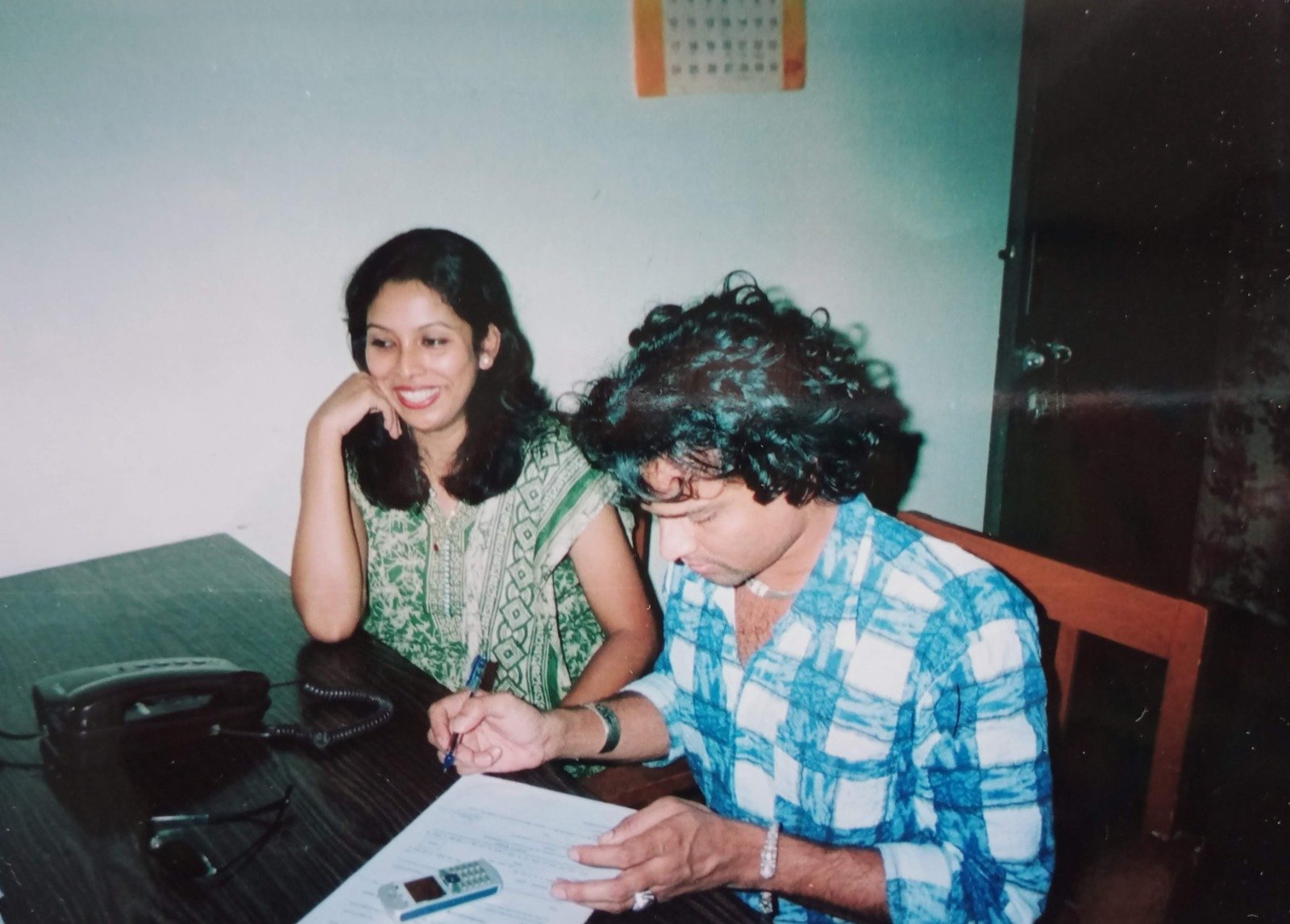
After the interview, we completed the formalities and signed the required papers. When I handed him the contract, Zubeen Da smiled and said he didn’t want any money for the interview — he was simply happy that we had invited him to the studio and spent such wonderful moments together. But since it was an official procedure, we had to go through with it.
By then, Zubeen Garg was no longer just a celebrated artist to me — he had become my elder brother, and I, his younger sister. We talked about many things — music, life, memories — and shared light-hearted laughter. Before parting ways, we took some cherished photographs and exchanged phone numbers.
When I asked him to stand for a photo, he chuckled and said teasingly, “She’s too naughty! She wants to prove that she’s taller than me!” Everyone laughed, and we clicked a few pictures together — moments I will treasure forever.It was almost dark when we finally stepped out of the studio. Ever thoughtful, Dada offered to drop me home, but Hasan Da assured him he would do so. Later that evening, after I reached home, my phone rang — it was Zubeen Da. He told me to stay in touch and to always consider him as my brother.
From that day onward, we remained in regular contact. I even had the chance to speak with Garima Bou a couple of times — each interaction filled with the same warmth and simplicity that defined them both.After the radio interview, Zubeen Da and I stayed in touch. Sometimes I would call him, and sometimes he would surprise me with a call, sharing updates about his latest projects or simply chatting like an affectionate elder brother.
One evening, he called with a cheerful tone in his voice and said, “Prarthana, I have some good news — I bought a new car!” I smiled, thrilled by his excitement. My knowledge about cars was (and still is) quite limited, but I congratulated him warmly and asked, “That’s wonderful, Dada! Which car did you buy?” “Skoda,” he replied proudly. “And what’s the colour?” I asked. “Black,” he said, his voice brimming with joy.
He went on enthusiastically, describing his new car in detail — every feature, every feeling of owning it. I listened, smiling all the while, and finally teased, “Wow, Dada! So when are you throwing the party for your new car?”It was such a simple conversation, yet it remains etched in my heart — a memory of his childlike excitement and our easy, affectionate bond.
After meeting Zubeen Da, I couldn’t wait to share my experience with my friends. I told them all about our conversations and the special bond we had formed. Some of them were a little jealous, while others became eager to meet him too. They insisted that I should introduce them to Dada, and I happily agreed.So, I spoke to Zubeen Da about it and told him the whole story. Smiling, he said that he would let me know the next time he came to Dibrugarh, and then my friends could meet him.
One fine day, Dada did come to Dibrugarh. As usual, we spoke over the phone, and my friends excitedly gathered at my home, waiting to meet him. It was around 7 p.m. when Dada called again. In his gentle, caring voice, he said, “Prarthana, I’m with a bit of an odd crowd right now, and it’s already quite late. It wouldn’t be safe for you and your friends to come here. Please tell them I’ll meet them another time.”
That moment once again showed the kind of person he was — thoughtful, protective, and caring like a true elder brother.Once, I went to Guwahati with a school friend for some personal work. While there, I called Zubeen Da and told him that I was in the city. He immediately said, “Come and meet me at my studio in Jonali!” Even though he was very busy those days, we managed to fix a time, and my friend and I went to his studio as planned.
We had to wait for a little while before he arrived. As soon as he entered, a few people approached him seeking help. With his usual generosity, Dada instructed one of his staff members to give them whatever they needed, and then turned to us with his warm smile.
Two big dogs were roaming around the studio, and I must admit, I was quite scared of them! Noticing that, Dada laughed softly and reassured me before taking us inside. He then gave us a little tour of his creative world — showing how recording, mixing, and editing were done. Watching him in his element, surrounded by music and energy, was truly fascinating.
Before we left, he looked at me and said kindly, “Keep doing your riyaaz sincerely. One day, you’ll get the chance to sing in this very studio.”Those words stayed with me — a blessing and motivation from my Dada that I’ll always cherish.
Over time, Zubeen Da rose to become a huge star, while I too got caught up in the flow of life—work, marriage, family, and career. Our communication gradually became less frequent as I kept moving from one place to another, exploring different opportunities. Yet, my respect and admiration for Zubeen Da never changed. I often told my daughter about him and always planned to take her to meet Dada the next time we visited Guwahati.
But that meeting never happened. Destiny, it seems, had other plans. I lost the chance to meet Zubeen Da forever. He left us far too soon. It’s often said that great souls are God’s favourites—and a divine soul like Zubeen Da was truly one of them. Perhaps God felt he was needed in heaven to spread his light there. Though Zubeen Garg is no longer with us physically, his music, his aura, and his good deeds will forever remain. I will always remember him as my elder brother, and the beautiful conversations and memories we shared will stay in my heart forever.
HAPPY BIRTHDAY ZUBEEN DA
Also Read: